Essential documentation for SAM renewal includes your Unique Entity ID (UEI), CAGE Code, Tax Identification Number, current legal business information, and updated contact details. Financial verification requires banking information and tax documents, while digital security necessitates multi-factor authentication setup. Start renewal 60-90 days before expiration to maintain continuous registration status. Accurate documentation prevents deactivation and establishes eligibility for federal contracts. The following checklist covers all critical requirements for successful 2025 renewal.
Core Documentation Required for SAM Renewal
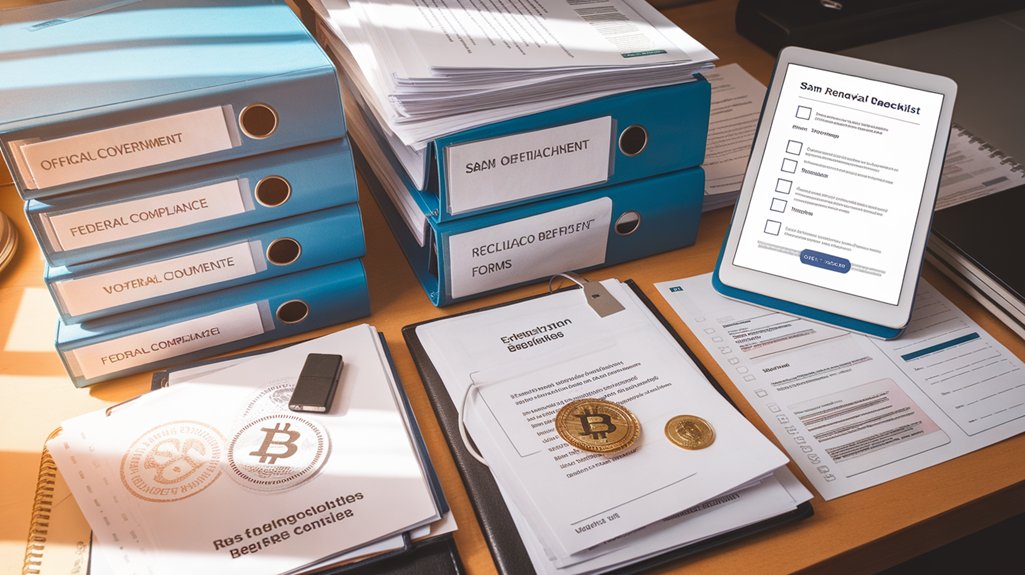
Preparedness serves as the foundation for a successful SAM renewal process. Organizations must gather several essential documents before beginning their renewal application to guarantee a smooth experience.
Being prepared with essential documentation is the cornerstone of efficient SAM renewal applications.
The renewal process requires verification of the entity’s Unique Entity ID (UEI) and current CAGE Code. Businesses must confirm their Tax Identification Number matches IRS records for proper entity verification. Additionally, companies need to review their legal business name and business structure documentation to ensure accuracy in the system.
Organizations should prepare current physical and mailing addresses, along with updated contact information for key personnel. The Authorizing Official’s information must be current, including valid email addresses and phone numbers. Since the renewal must occur at least every 12 months or sooner if entity information changes, keeping these details updated is crucial.
Entities must also gather documentation about their key business activities, industry classification codes, and employee size to accurately represent their organization. Strategic planning helps organizations avoid common pitfalls and maximize efficiency throughout the renewal process. Regular and thorough document updates are essential for maintaining compliance with federal regulations and ensuring visibility with agencies seeking services. Having these materials ready considerably reduces renewal processing time and prevents potential registration lapses.
Financial and Legal Verification Documents

Five critical financial and legal documents form the backbone of a successful SAM renewal application. Organizations must prepare their Tax Identification Number (TIN) documentation to verify financial identity, along with updated bank account details for federal payment processing through direct deposit arrangements.
Entities must also submit verification of their legal structure, including current articles of incorporation and detailed ownership structure documentation. This information guarantees proper classification within the system and compliance with federal contracting requirements. Failing to accurately provide these documents can lead to immediate registration deactivation and loss of eligibility for government opportunities. The entire renewal process should be completed within the 365-day period to maintain continuous registration status. A current DUNS number is also required as part of the essential identity verification process for all entities seeking government contracts.
Additionally, organizations need to provide:
- Current CAGE Code verification documents
- Financial compliance certifications
- Corporate bylaws and resolutions
- Banking information with account holder verification
- Business accreditation and compliance certificates
These documents collectively establish an organization’s legitimacy and eligibility for federal contracts.
Entities should maintain accurate records of these materials year-round to streamline the renewal process and prevent potential delays in SAM registration maintenance.
Digital Identity and Security Requirements

The extensive digital identity and security framework for SAM.gov renewals establishes multiple layers of protection for federal contractor information.
SAM.gov’s layered security architecture safeguards contractor data through rigorous digital identity verification protocols.
Government contractors must navigate several digital identity verification steps while adhering to robust security protocols throughout the renewal process. Annual renewal is mandatory to maintain accuracy of contractor credentials in the central repository. Implementing MFA protection is essential for safeguarding sensitive information and preventing unauthorized access to your SAM account.
Entities must prepare the following security elements:
- Login credentials – Each user needs individual SAM.gov username/password credentials with multi-factor authentication enabled, meeting password complexity requirements of 12+ characters with special characters.
- Entity verification data – Your Unique Entity ID (UEI), CAGE code, and TIN must align perfectly with IRS records and public registration information.
- Role-based access controls – Properly delegate access through Entity Administrator and User roles, with clear third-party authorization if using registration services.
- Encryption standards compliance – Guarantee browsers support TLS 1.2+ encryption, avoid storing credentials locally, and understand that all sensitive data is protected under FIPS 140-2 federal standards.
Starting the renewal process 60-90 days before expiration ensures you have sufficient time to address any security verification issues that might arise during the renewal workflow.
Frequently Asked Questions
Can I Renew My SAM Registration Before the 60-Day Expiration Window?
Yes, organizations can initiate SAM registration renewal at any time before the 60-day expiration window.
Early renewal benefits include avoiding processing delays, guaranteeing continuous registration status, and allowing time to address any documentation issues that may arise.
The registration process remains the same regardless of timing, though starting early provides a buffer for potential complications.
Businesses should consider beginning their renewal 60-90 days before expiration to guarantee a smooth shift without interruption to federal contracting eligibility.
How Do International Businesses Verify Their Banking Information for SAM Renewal?
International businesses must complete several steps for banking verification during SAM renewal.
The process requires bank account details to match the legal entity name and TIN records. Organizations need bank-issued documentation, such as a stamped letter, confirming account ownership.
International verification includes validating wire transfer data through SAM.gov’s integrated system and ensuring currency compatibility with USD transactions.
Banking compliance also requires cross-checking ACH routing numbers with appropriate international banking authorities.
What Happens if My Cage/Ncage Code Expires During Renewal?
If a CAGE/NCAGE code expires during renewal, several consequences occur immediately.
Companies face automatic inactivation in SAM, preventing contract modifications and new awards.
The cage code impact includes removal from procurement databases and disqualification from bid opportunities.
Renewal consequences extend to payment processing delays and inability to receive task orders under existing contracts.
Organizations must complete a full SAM re-registration to reactivate their code, which typically takes 2-6 weeks for complete restoration.
Are There Expedited Processing Options for Urgent Contract Requirements?
While SAM.gov offers no official expedited processing options, companies facing urgent contract requirements have alternatives.
Third-party services like Government Services Exchange can accelerate processing through their system expertise. These providers typically offer faster turnaround than the standard 10-15 business day timeline for manual renewals.
Companies should verify third-party credentials before proceeding and maintain documentation of all submission confirmations.
Starting the renewal process 60 days before expiration remains the most reliable approach.
Can Multiple Administrators Manage Different Aspects of Our SAM Renewal?
Yes, multiple Entity Administrators can manage different aspects of a SAM renewal. This administrator roles approach creates redundancy and enhances oversight by distributing responsibilities.
Each administrator has equal capabilities to update entity information, manage renewal processes, and maintain essential documentation. This management strategy prevents single points of failure if one administrator becomes unavailable.
Organizations can assign various administrators to oversee specific components like financial information, business classifications, or entity details for more efficient renewal management.
📞 Work With the Leading SAM.gov Experts Today
If your organization needs to stay eligible for federal funds, don’t take chances. Work with the professionals trusted by thousands nationwide.
Don’t risk your next contract. Partner with the most experienced SAM registration team in the country.
Take the First Step by Clicking Below: https://federalprocessingregistry.com/register-online/
20,000+ Registrations Completed
Check out our 1000+ and growing Google 5-Star Reviews
📍 www.federalprocessingregistry.com
📞 Call: (888) 618-0617
📩 Email: help@federalprocessingregistry.com